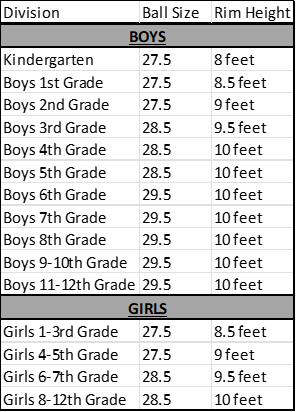
PARKLAND BASKETBALL CLUB RULES:
1.0 GOVERNING RULES. Florida High School Athletic Association rules will govern play unless otherwise noted herein.
2.0 DIVISIONS. The player’s (the “Player”) school grade will determine the division he/she participates in. Divisions may be made up of Players in one or more school grades depending on the number of Players in each school grade. Each division will be governed by a director (the “Division Director”).
3.0 TEAMS AND COACHES. Each team (the “Team”) will consist of a minimum of 7 Players and a maximum of 8 Players. 8-Player Teams are preferred. The number of Teams will be determined by the number of registered Players. There will be a limit of two coaches per Team, one head coach (the “Head Coach”) and one assistant coach (the “Assistant Coach”). Only one coach is permitted to stand during the game. The other coach must remain seated on the bench.
4.0 PLAYER EVALUATIONS. Each division will conduct a player evaluation (the “Evaluation”). Each Player will be required to attend the Evaluation to be guaranteed a roster spot on a Team. During the Evaluation, all Players will perform a number of routine skills. Head Coaches will observe and rate the Players based on their ability. Players who miss the Evaluation or register late will not be guaranteed a roster spot, but may be eligible for the Player Draft depending upon the number of participants in their division. The purpose of the Evaluation is to achieve parity amongst the teams within a division. Head coaches, Division Directors and all league members privy to the Players’ ratings shall keep such information confidential.
5.0 TEAM SELECTIONS. A Player draft to select teams (the "Player Draft") shall be scheduled by the Division Director after the Evaluation. Teams will be chosen by the Head Coaches during the Player Draft. No one other than the Division Director and the Head Coaches shall attend the Player Draft. Each division shall use a “Modified Snake” type draft. Example 1 - the Team having the first selection in the first round of the draft will select first in Rounds 1, 4, and 6, and last in Rounds 2, 3, 5, 7 and 8. Example 2 - the Team having the last selection in the first round of the draft will select first in Rounds 2, 3, 5, 7 and 8 and last in Rounds 1, 4 and 6. The order of the Draft will be selected by random draw, however, a Head Coach whose child is rated in the top two rounds of the Player Draft will be slotted based on his/her rating and that Head Coach’s Team will be assigned a selection in the first and second round accordingly. Example 1 - if the Head Coach’s child is the 3rd highest ranked player in an 8-team division, the Head Coach will select his child with the 3rd selection in Round 1 and will then have the 6th selection in the Rounds 2 and 3. Example 2 - if the Head Coach’s child is the 15th highest ranked Player in an 8-team division, the Head Coach will have the second selection in Round 1 and will select his child with the 7th selection in Round 2. If a Head Coach’s child’s skill rating is outside of the first two rounds of the Player Draft, that Head Coach’s child will be slotted in a draft round in accordance with his/her skill rating. Example - if the Head Coach’s child is slotted in the fifth round as a result of his skill rating, the Head Coach must select his child in Round 5 of the Player Draft. All Players must be drafted. A Head Coach may not be assigned a Player prior to the draft. In the event a Head Coach would like to coach with a specific Assistant Coach, the Head Coach must draft the Assistant Coach's child; Exception - in the event all other Head Coaches consent to said request, the Assistant Coach's child will be assigned to the requesting Head Coach one round earlier than the round that Assistant Coach's child is slotted. Players must play for the Team that selects them. Under extreme circumstances, the Division Director has the authority to switch a Player to another Team if it is determined that such a change is critically necessary. Siblings in the same Division will automatically be placed on the same Team. Parents may request however that siblings not be drafted to the same Team. Note: Once the first sibling is drafted, the other sibling will be placed on the same Team in the Draft round they are slotted in according to their Evaluation rating. Once the Draft is concluded and no other special circumstances are acknowledged, there will be no trading of Players for any reason. If a trade is proposed for a special circumstance during the Draft, and the Division Director concurs, the Head Coaches must approve the trade by majority vote. Once a Player is drafted or placed on a Team, the Player will remain on that Team for the duration of the season, unless an unforeseen problem arises that must be resolved by the Division Director.
6.0 GAME SCHEDULES. Games will be played in accordance with the schedule set by the League Board. All teams will play approximately 12 regular season games followed by a double-elimination playoff with teams being seeded by record for the first round.
7.0 PRACTICE SCHEDULES. Teams are limited to one 1-hour practice sessions per week prior to the commencement of regular season games and one 1-hour practice session during the regular season and playoffs. Practice times and locations will be made available to the Head Coaches by the League Board.
8.0 GAME RULES: Florida High School Athletic Association rules will govern play unless otherwise noted herein.
8.1 STARTING TIME. All games will start at the scheduled time. If a team cannot field enough players, a 10-minute grace period will be allowed. If a team still has fewer than 4 players after the grace period, the game will be forfeited.
If a team has exactly 4 players, the opposing team head coach can choose to play with 4 players OR 5 players.
8.2 LENGTH OF GAMES. Games will consist of four 8-minute quarters. There will be a one-minute intermission between the 1st and 2nd quarters, and the 3rd and 4th quarters, with a two-minute intermission at halftime.
During the regular season, if the game is tied at the end of regulation, one 2-minute overtime period will be played. If the score remains tied after overtime, the game will end in a tie. In playoff games, additional 2-minute overtime periods will be played until the tie is broken.
8.3 RUNNING CLOCK. Each quarter will use a running clock, except for the last two minutes of the 4th quarter, all overtime periods, and the final 10 seconds of the first three quarters. During running clock time, the clock will only stop for timeouts, free throws, injuries, or at the referee’s discretion.
Exception: If a team is ahead by 20 points or more at any time in the 4th quarter, or by 15 points or more in the final 2 minutes of the 4th quarter, the clock will only stop for timeouts or at the referee’s discretion, unless the point difference later drops to 10 points or less.
8.4. TIMEKEEPERS AND SCOREKEEPERS. Timekeepers and scorekeepers are prohibited from coaching, communicating with, or instructing Players during the game. No one under the age of 16 will be allowed at the scorer's table, unless specifically authorized by a Division Director.
8.5 MINIMUM PLAYING TIME. Each player present before the start of the 2nd quarter must play two full 8-minute quarters, one in each half.
No player can play all 4 quarters until every other player has played at least 3 full quarters (unless as noted below in 8.6)
A player arriving after the start of the 2nd quarter will, at the head coach’s discretion, play one or two 8-minute quarters in the second half.
A player arriving after the start of the 3rd quarter is not eligible to play.
8.6 MAXIMUM PLAYING TIME:
Teams with 7 or More Players. If a team has 7 or more players before halftime, no player may play all 4 quarters. Each player must sit at least one full quarter. If some players arrive after the start of the 2nd quarter, the coach must ensure that as many players as possible sit out one full quarter.
Teams with 6 or Less Players vs. Teams with 7 or More Players. If a team has 6 or fewer players at the start of the game, the opposing team with 7 or more players may select up to two players from the team with 6 players to sit one full quarter each. The coach of the team with 6 players is responsible for informing the opposing coach of their team’s player count.
If the coach with 6 players fails to provide this information, the opposing coach may designate two players from the team with 6 players to sit one full quarter each, at any time before the start of the 4th quarter. By default, the team with 6 players must sit their two highest drafted players. However, the opposing coach may request that different players be selected to sit, and the coach of the team with 6 players must comply with this request.
• If the opposing team is missing their FIRST or SECOND draft pick the opposing coach may only designate ONE player to sit one full quarter.
• If the opposing team is missing their FIRST AND SECOND draft pick, no designation applies.
Teams with 6 Players vs. Teams with 6 Players. Any player may play all 4 quarters. The only substitution rule is that each player must play one full quarter in each half and a minimum of 3 full quarters in the game.
Teams with 5 or Less Players vs. Teams with 6 or More Players. If a team has only 5 players or less in attendance, the opposing coach may select one player from their team who will be allowed to play all 4 quarters.
8.7 SUBSTITUTIONS FOR INJURY/FOULS. A player must leave the game if they are injured or ill, foul out, commit 4 fouls in their first quarter of play, or receive a technical foul.
A player who receives a technical foul must sit out the remainder of the current quarter and the next quarter, or if the foul occurs after the end of a quarter, they must sit out the next two quarters.
Each quarter the player sits counts as a quarter played.
The player who replaces them will not receive credit for playing in that quarter.
The player who has played the least amount of time on the bench will replace the player leaving the game.
If two or more players on the bench have played the same amount of time, that team’s head coach will decide which player replaces the one leaving.
If an injured player returns during the same quarter, they will replace the player who substituted for them.
8.8 1st QUARTER SUBSTITUTIONS. At the head coach's request, a referee will call an “Official Time-out” at the first stoppage of play (including made baskets) at or after the 4-minute mark of the 1st quarter, allowing teams with 7 or more players to make one substitution.
• Teams with 7 players may substitute 1 player.
• Teams with 8 players may substitute 2 players.
The players entering and leaving the game during this time will not receive credit for playing an entire quarter, and both must play the entire 2nd quarter. This rule is designed to help coaches divide playing time as equally as possible.
Teams with 6 players playing against another team with 6 players may make 1 substitution in the first quarter if desired.
8.9 4th QUARTER SUBSTITUTIONS. Player substitutions can be made at any time during the 4th quarter, as long as both the players entering and leaving the game have each played 2 full quarters.
Since every player must play at least one full quarter in each half, no substitutions are allowed in the 2nd or 3rd quarters, except for injury substitutions.
8.10 CHECKING IN. All players must check in at the scorer’s table before entering the game. Players who check in in violation of Rules 8.5 through 8.9 will not be permitted to enter the game.
8.11 TEAM BENCH RULES. Only the team, head coach, and assistant coach are permitted on the bench. The head coach is the only person allowed to stand during the game.
The first violation will result in a warning, with a technical foul issued for each subsequent violation. If a technical foul is issued to the head coach, assistant coach, or any player on the bench, the head coach will lose the privilege to stand for the remainder of the game.
8.12 START OF GAME & OVERTIME POSSESSION. A tip-off will determine possession at the start of the game (and any overtime period).
8.13 DIVISION SPECIFIC RULES.
A. In divisions where full court defense is permitted, a Team leading by 15 points or more may not play full court defense.
B. KINDERGARTEN, BOYS 1ST, BOYS 2ND, GIRLS 1ST, GIRLS 2ND AND GIRLS 3RD GRADE
1. DEFENSE: MAN-TO-MAN ONLY AND INSIDE THE 3-POINT ARC. Defense will be man-to-man ONLY and the defensive players MUST BE WITHIN 3 feet of the offensive player they are covering. Defense outside the 3-point arc is prohibited at all times. Defensive players cannot pressure the offensive player once he/she has gained possession of the ball outside the offensive 3-point arc. If the offensive team loses control of the ball outside the arc, the defensive team cannot try to take possession of the ball until it crosses inside the arc. Defensive players may switch on picks, however, only 1 player can guard the offensive player at a time. The only exception is in the paint; there are no double-teaming rules in the paint. If a team is called for double teaming, the opposing team will shoot 2 free-throws on the 3rd time double teaming is called and every time thereafter; any offensive player on the court may take the free-throws. Illegal defense aimed to disrupt a fastbreak shall result in a 2 warnings, followed by a technical foul.
2. INBOUND PLAYS. All inbound plays in the front court will take place from the sideline above the free-throw line.
3. FREE-THROWS. Free-throws will be taken from a line inside the foul line.
4. GUARD POSITION RULE. All players must play at least 1 full quarter at the guard position. This entails either in-bounding or dribbling/passing the ball over mid-court in all back-court situations.
5. RULE INTERPRETATION. Final decisions of rule interpretations will be made by the referee.
6. OFFENSIVE PLAY - NO ISOLATION. Coaches are encouraged to form offensive strategies that incorporate involvement for all players. The “spread” or “4-corner” offense with the intention of player “isolation”, whether for purposes of helping an offensive player to score or keeping an offensive player away from the basket in order to minimize the number of defensive players near the basket, is illegal. On a violation of Rule 12.9, the referee will stop the game and award the ball to the defensive team. A “spread offense” is different from the offensive team “spreading the floor”. Spreading the offensive floor followed by team movement towards the basket is sound basketball strategy and is not a spread offense in terms of “isolation”. Thus, setting up an offense in a spread position in order to begin the offensive play is not illegal.
7. OFFENSIVE PLAY - NO DELAY. Because defense outside the 3-point arc is prohibited at all times, running time off the clock to gain an advantage by keeping the ball outside the 3-point line is also prohibited. Accordingly, the offensive team, while in the front court, must make an effort to advance the ball across the 3-point arc. Failure to do so within 10 seconds or continuously moving the ball back outside the 3-point arc for the purpose of delay shall be a violation, resulting in a stoppage of play and the ball being awarded to the defensive team.
C. BOYS 3RD and GIRLS 4TH and 5TH GRADE
BACKCOURT DEFENSE. Backcourt defense is prohibited. Defensive players cannot pressure the offensive players once they have gained possession of the ball in the backcourt. The ball must cross into the front-court before a defensive player can pressure the ball. If the offensive team loses control of the ball in the backcourt, the defensive team cannot take possession of the ball until it crosses the halfcourt line. Illegal defense aimed to disrupt a fastbreak shall result in a 2 warnings, followed by a technical foul.
END OF GAME. If, and only if, a team is down by 5 points or less, with under thirty (:30) seconds left in the fourth quarter (or Overtime), the defending team is allowed to play defense in the backcourt. There are no other exceptions.
FREE-THROWS. Free-throws shall be taken from behind the free-throw line. The shooter may jump over the free-throw line during the follow through of the free-throw attempt.
D. BOYS 4TH, 5TH, 6TH, 7TH, 8TH GRADE, and GIRLS 6-7TH GRADE. All Club rules apply with the exception of the rules stated herein.
BACKCOURT DEFENSE. Backcourt defense is prohibited, except in the last 2 minutes of the 4th quarter and any overtime period. Defensive players cannot pressure the offensive players once they have gained possession of the ball in the backcourt (except in the last 2 minutes of the 4th quarter and any overtime period). The ball must cross into the front-court before a defensive player can pressure the ball. If the offensive team loses control of the ball in the backcourt, the defensive team cannot take possession of the ball until it crosses the half-court line. Illegal defense aimed to disrupt a fastbreak shall result in a 2 warnings, followed by a technical foul.
8.14 TIME-OUTS. Each team is permitted 4 time-outs per game, with a maximum of 3 time-outs carried over to the second half. Teams will receive one additional time-out for each overtime period.
8.15 INJURY/ILLNESS. Any player who suffers a head injury or displays symptoms of heat exhaustion, heat stroke, or other related conditions during the game may only continue to play at the referee's discretion. The player's health and safety will be the sole determining factor.
8.16 UNIFORMS. Players must wear unaltered league-provided uniforms for every game. Failure to comply will result in a technical foul at the start of the game or when the violation is noticed by the official.
Jerseys must be tucked in at the start of each quarter and must be re-tucked during any stoppage of play. If a player does not have the issued jersey, they may wear a substitute shirt without numbers, provided it does not conflict with the color of the opposing team’s jerseys. The referee must be informed of the substitute shirt prior to the game.
8.17 PROTESTING A GAME. The head coach of a team may lodge a protest with their division director within 4 hours of the conclusion of a game if they believe the opposing team violated a club rule that gave them an unfair advantage. The Board of Directors will review the protest and issue a determination.
8.18 INCLEMENT WEATHER. Teams scheduled to play must come to the park unless the game has been officially canceled by the division director or a board member. Player safety is the primary concern and will determine whether a game should be canceled.
If a game is canceled, the division director will contact their coaches, who are responsible for informing their players. The league will also update its website accordingly.
If a regular-season game is suspended due to weather or other conditions, it will be considered complete if at least 3 quarters have been played. If a playoff game is suspended, it will be rescheduled and played from the point where it left off.
8.19 COVID-19 PROTOCOL. The COVID-19 Protocol posted on the League's website shall apply to all Club players, coaches, family members and spectators. In the event of a conflict between the rules herein and the COVID-19 Protocol, the COVID-19 Protocol shall govern.
8.20 PLAYOFFS. All teams qualify for the Playoffs. Seeding will be determined by record and in accordance with Team Sideline’s playoff system. In the event of a tie, the system uses a series of pre-set tie breakers. The final tie breaker is a system auto-generated coin flip. The league will not alter or override these tie breakers.
The playoff brackets will vary based on the size of the division. Play in games and bye weeks are determined by Team Sideline based on division size. All Playoffs are double elimination.
8.21 CONDUCT. Any club member—including players, parents, and coaches—who engages in unsportsmanlike behavior at the park (e.g., disrespecting coaches, board members, or officials; using profanity; threatening injury; or causing a situation where injury may occur) will face disciplinary action as determined by the Board.
• A player or coach who commits unsportsmanlike conduct will receive a double technical foul and be ejected from the game.
• Ejected players or coaches will serve a 1-game suspension and miss the next game.
• Accumulating 4 points in a season (1 point per technical foul and 2 points for a double technical) will result in expulsion from the league for the remainder of the season, with no refund.
• Two instances of unsportsmanlike conduct in a season will also result in automatic expulsion from the league, with no refund.
Severe Violations:
• Any verbal threat, physical assault, or intentional injury will lead to immediate ejection from the game and suspension from the league. No refund will be given.
• The Board may review each case of unsportsmanlike conduct and assign additional disciplinary action as deemed appropriate.
Coaches Gamesmanship:
• If the referees believe that any coach is using “gamesmanship” to circumvent rules designed to ensure fairness and equal playing time, the coach will be assessed a technical foul and two technical foul shots awarded to the opposing team.
Parent, Player and Coach Code of Conduct:
• All members of the league are further subject to the Parent, Player and Coach code of conduct forms that were signed during registration. Additional language regarding violations and discipline can be found in those documents. All applicable language can be found at Parklandbasketball.com under the Terms and Conditions link.
Spectator Conduct:
• The Head Coach is responsible for the conduct of their assistant coach, players, and parents/spectators
• If a parent/spectator interferes with the game, the referee will stop play until the situation is addressed.
• If the referee deems it necessary, the parent/spectator must immediately leave the courts and move to the parking lot.
• Failure to immediately leave the courts or continuing to interfere with the game will result in two technical foul shots being awarded to the opposing team.
• If the violating parent/spectator refuses to leave the courts and move to the parking lot, the player of the offending parent or spectator will be ejected, and two additional technical foul shots will be awarded to the opposing team until the violator complies.
• If a parent/spectator who has been suspended from appearing at a game disobeys the suspension and is present, their child will be immediately ejected from the game and two technical foul shots awarded to the opposing team.
Game Area Restrictions:
• Only players, coaches, referees, scorekeepers, and timekeepers are allowed inside the fenced area during games. Teams waiting to play must remain outside the fenced area.
• If this rule is violated, the referee will stop the game until all violators are removed. Repeated violations will result in a technical foul for the offending team, removal of the violating parent/spectator, and ejection of the child if applicable.
Interference with Scorekeeper:
• If requested by the referees or head coach, parents/spectators must not view the game directly behind the scorer's table. Failure to comply may result in a technical foul.